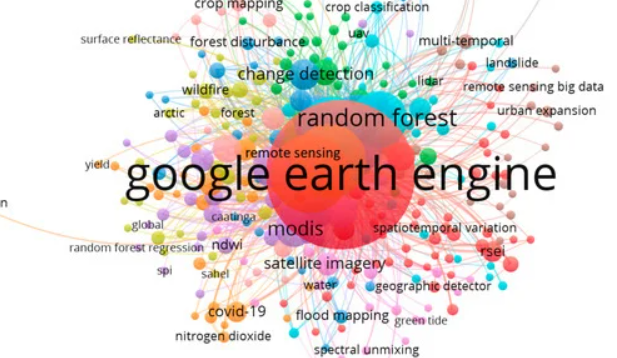
Python for Modern Geospatial AI & Computer Vision

5 Available Seats with 50% Discount
Google Earth Engine training

You can start anytime. It’s our private training program, 1 vs 1. 

Complete 32-Week Industry-Focused Curriculum

Course Overview

This industry-oriented training program is designed to build strong practical expertise in Python programming, geospatial analysis, machine learning, computer vision, deep learning, and cloud-based geospatial AI workflows. The curriculum progresses from foundational Python programming to advanced AI-driven remote sensing applications using modern geospatial technologies.

  • Duration: 32 Weeks
  • Class Frequency: 1 Day per Week
  • Session Duration: 2 Hours per Session
  • Total Contact Hours: 64 Hours
  • Capstone Mentoring: Additional Guided Support
  • Learning Format: Hands-on Practical Training + Real-world Projects

PHASE 1: Python Foundations (Weeks 1–4)

Total Hours: 8

Week 1: Introduction to Python Programming

Topics Covered

  • Introduction to Python for Geospatial Applications
  • Installing Python using Anaconda & Miniconda
  • Jupyter Notebook Environment
  • VS Code Setup and Configuration
  • Python Syntax Fundamentals
  • Variables and Data Types
  • Operators and Expressions
  • Conditional Statements
  • Loops (For & While)
  • User Inputs and Output Formatting

Practical Exercises

  • Basic Python coding exercises
  • Simple geospatial coordinate calculations
  • Data type conversion practices

Week 2: Functions and File Handling

Topics Covered

  • Python Functions
  • Function Parameters and Return Values
  • Modules and Libraries
  • Importing External Packages
  • File Handling Operations
  • Reading & Writing CSV Files
  • Working with JSON Data
  • Exception Handling and Debugging

Mini Project

Location Dataset Automation

  • Reading geospatial coordinate datasets
  • Automating CSV processing
  • Exporting cleaned outputs

Week 3: Numerical Computing with NumPy

Topics Covered

  • Introduction to NumPy
  • Creating NumPy Arrays
  • Array Indexing & Slicing
  • Vectorized Operations
  • Broadcasting
  • Statistical Computations
  • Matrix Mathematics
  • Multi-dimensional Arrays

Practical Exercises

  • Raster-like matrix operations
  • Numerical transformations for satellite data

Week 4: Data Analysis using Pandas

Topics Covered

  • Pandas DataFrames
  • Reading and Writing Tabular Data
  • Data Cleaning Techniques
  • Handling Missing Values
  • Filtering and Aggregation
  • Time-Series Data Basics
  • DateTime Operations
  • Exploratory Data Analysis

Mini Project

Temporal Rainfall Analysis

  • Rainfall trend analysis
  • Monthly and yearly aggregation
  • Visualization of rainfall patterns

PHASE 2: Core Geospatial Python (Weeks 5–10)

Total Hours: 12

Week 5: Introduction to GeoPandas

Topics Covered

  • Introduction to Geospatial Python
  • GeoPandas Fundamentals
  • Spatial Vector Data
  • Shapefile Structure
  • GeoJSON Format
  • Geometry Types
    • Point
    • Line
    • Polygon
  • Spatial Attribute Tables

Practical Exercises

  • Loading vector datasets
  • Mapping administrative boundaries

Week 6: Spatial Analysis using GeoPandas

Topics Covered

  • Spatial Joins
  • Overlay Analysis
  • Buffer Operations
  • Proximity Analysis
  • Intersection and Union
  • Clipping Vector Layers

Mini Project

Urban Buffer Analysis

  • Road buffer creation
  • Urban accessibility assessment
  • Service zone mapping

Week 7: Coordinate Reference Systems (CRS)

Topics Covered

  • Understanding Coordinate Systems
  • Geographic vs Projected CRS
  • EPSG Codes
  • Datum Concepts
  • Reprojection Techniques
  • PyProj Library
  • Coordinate Transformation

Practical Exercises

  • Reprojecting datasets
  • CRS correction workflows

Week 8: Raster Data Processing with Rasterio

Topics Covered

  • Raster Data Fundamentals
  • GeoTIFF Structure
  • Raster Metadata
  • Reading Single & Multi-band Raster
  • Raster Visualization
  • Pixel Resolution Concepts

Practical Exercises

  • Loading Sentinel and Landsat imagery
  • Multi-band visualization

Week 9: Raster Analysis & Vegetation Indices

Topics Covered

  • Raster Clipping & Masking
  • Raster Calculations
  • Band Math
  • NDVI Computation
  • Vegetation Analysis
  • Raster Exporting

Practical Exercises

  • Vegetation health monitoring
  • NDVI-based analysis

Week 10: Time-Series Raster Analysis

Topics Covered

  • Multi-temporal Raster Processing
  • Raster Stacking
  • Change Detection Techniques
  • Temporal Trend Analysis
  • Seasonal Vegetation Monitoring

Mini Project

NDVI Trend Monitoring

  • Time-series NDVI generation
  • Vegetation trend assessment
  • Spatial change visualization

PHASE 3: Machine Learning for Geospatial Applications (Weeks 11–15)

Total Hours: 10

Week 11: Introduction to Machine Learning

Topics Covered

  • Fundamentals of Machine Learning
  • Types of Machine Learning
    • Supervised Learning
    • Unsupervised Learning
  • Training & Testing Data
  • Feature Engineering
  • Data Normalization
  • Model Workflow

Practical Exercises

  • Preparing geospatial training datasets

Week 12: Machine Learning Algorithms

Topics Covered

  • Random Forest Classifier
  • Support Vector Machine (SVM)
  • Feature Extraction from Raster Data
  • Model Training Workflow
  • Hyperparameter Concepts

Practical Exercises

  • Land cover classification using ML

Week 13: Model Validation & Accuracy Assessment

Topics Covered

  • Accuracy Assessment
  • Confusion Matrix
  • Precision, Recall & F1-Score
  • Kappa Coefficient
  • Cross-validation Techniques
  • Overfitting vs Underfitting

Practical Exercises

  • Classification accuracy evaluation

Week 14: Advanced Feature Engineering

Topics Covered

  • Multi-sensor Data Fusion
  • Sentinel-1 & Sentinel-2 Integration
  • Texture Analysis
  • GLCM Texture Features
  • Feature Stacking
  • Dimensionality Reduction

Practical Exercises

  • Multi-source feature generation

Week 15: Machine Learning Mini Project

Mini Project

Land Cover Classification using Multi-Sensor Data

  • Data preprocessing
  • Feature extraction
  • ML model training
  • Classification map generation
  • Accuracy validation

PHASE 4: Computer Vision for Remote Sensing (Weeks 16–20)

Total Hours: 10

Week 16: OpenCV Fundamentals

Topics Covered

  • Introduction to Computer Vision
  • OpenCV Basics
  • Image Reading & Writing
  • Image Filtering
  • Edge Detection
  • Image Enhancement Techniques

Practical Exercises

  • Satellite image enhancement

Week 17: Image Segmentation Techniques

Topics Covered

  • Image Segmentation Concepts
  • Thresholding Methods
  • Morphological Operations
  • Binary Image Processing
  • Connected Components

Practical Exercises

  • Water body segmentation

Week 18: Object Detection Concepts

Topics Covered

  • Object Detection Fundamentals
  • Sliding Window Techniques
  • Feature Descriptors
  • ORB Features
  • SIFT Concepts
  • Bounding Box Concepts

Practical Exercises

  • Feature extraction from aerial imagery

Week 19: Deep Learning Foundations for Vision

Topics Covered

  • Neural Network Basics
  • Convolutional Neural Networks (CNN)
  • Convolution Operations
  • Activation Functions
  • Pooling Layers
  • Feature Maps

Practical Exercises

  • Simple image classifier development

Week 20: Computer Vision Mini Project

Mini Project Options

  • Rooftop Extraction
  • Flood Extent Segmentation
  • Building Footprint Mapping

Workflow

  • Data preprocessing
  • Image segmentation
  • Object extraction
  • Accuracy evaluation

PHASE 5: PyTorch & Deep Learning for Geospatial AI (Weeks 21–27)

Total Hours: 14

Week 21: Introduction to PyTorch

Topics Covered

  • PyTorch Installation
  • Tensor Operations
  • Automatic Differentiation (Autograd)
  • Building Simple Neural Networks
  • Training Loops

Practical Exercises

  • Basic neural network implementation

Week 22: CNN Implementation in PyTorch

Topics Covered

  • CNN Architecture Implementation
  • Custom Dataset Creation
  • DataLoader for Raster Patches
  • Batch Processing
  • Model Training

Practical Exercises

  • Satellite patch classification

Week 23: Transfer Learning

Topics Covered

  • Transfer Learning Concepts
  • Pre-trained Models
  • ResNet Architecture
  • Fine-tuning Techniques
  • Model Optimization

Practical Exercises

  • Satellite image classification using ResNet

Week 24: Semantic Segmentation

Topics Covered

  • Semantic Segmentation Concepts
  • U-Net Architecture
  • Encoder-Decoder Networks
  • Loss Functions
    • CrossEntropy Loss
    • Dice Loss
  • Segmentation Metrics

Practical Exercises

  • Flood or building segmentation

Week 25: SAR & Optical Data Fusion

Topics Covered

  • SAR Fundamentals
  • Sentinel-1 Preprocessing
  • Speckle Noise Concepts
  • SAR & Optical Fusion Strategies
  • Multi-source AI Integration

Practical Exercises

  • SAR-based flood mapping

Week 26: Time-Series Deep Learning

Topics Covered

  • Sequential Data Concepts
  • LSTM Networks
  • NDVI Forecasting
  • Time-Series Prediction
  • Temporal Pattern Learning

Practical Exercises

  • Vegetation forecasting

Week 27: Deep Learning Mini Project

Mini Project Options

  • Deep Learning Land Cover Mapping
  • Flood Mapping using U-Net
  • Building Detection using CNN
  • SAR-based Segmentation

Workflow

  • Dataset preparation
  • Model training
  • Performance evaluation
  • Prediction mapping

PHASE 6: Web GIS, Cloud Computing & Deployment (Weeks 28–30)

Total Hours: 6

Week 28: Flask API Development

Topics Covered

  • Introduction to Flask
  • Building ML APIs
  • GeoJSON Services
  • API Endpoints
  • Model Deployment Concepts

Practical Exercises

  • Serving geospatial ML predictions

Week 29: Web GIS Dashboard Development

Topics Covered

  • Leaflet Fundamentals
  • Interactive Web Mapping
  • Dashboard Development using Dash
  • Frontend Integration
  • Geospatial Visualization

Practical Exercises

  • Building interactive GIS dashboards

Week 30: Cloud-Based Geospatial Processing

Topics Covered

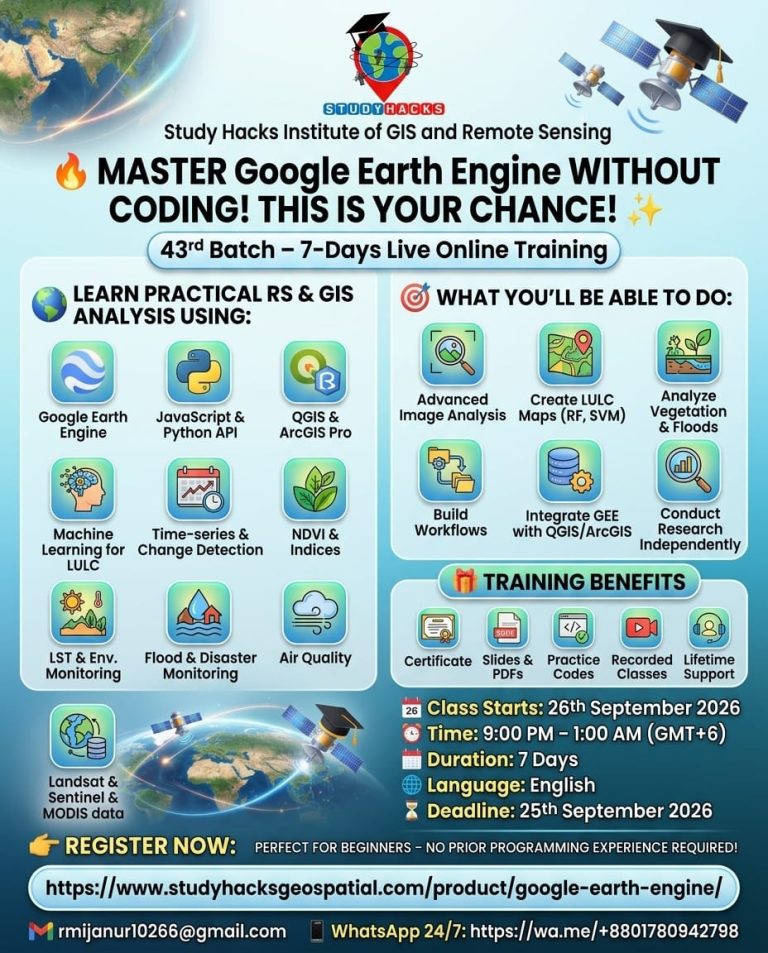
  • Google Earth Engine Python API
  • Cloud Computing Concepts
  • Large-scale Raster Processing
  • Scalable Geospatial Analysis
  • Automated Remote Sensing Pipelines

Practical Exercises

  • Cloud-based geospatial workflow automation

PHASE 7: Capstone Project & Industry Simulation (Weeks 31–32)

Total Hours: 4 + Guided Mentoring

Week 31: Capstone Planning

Topics Covered

  • Project Topic Selection
  • Problem Definition
  • Data Pipeline Design
  • Workflow Architecture
  • Research Methodology

Deliverables

  • Project proposal
  • Dataset preparation
  • Workflow planning

Week 32: Final Project Presentation

Topics Covered

  • Final Model Demonstration
  • Visualization & Reporting
  • Industry Feedback Simulation
  • Presentation Skills
  • Project Documentation

Deliverables

  • Final report
  • Presentation slides
  • Working AI workflow

Capstone Project Options

Students will select one industry-level project:

  1. Deep Learning Flood Mapping using SAR + Optical Data
  2. Crop Yield Prediction using LSTM Networks
  3. Building Detection using U-Net
  4. Urban Heat Island Forecasting
  5. Mineral Prospectivity Mapping using ML + Texture Features
  6. Deforestation Monitoring using Deep Learning
  7. Landslide Susceptibility Mapping
  8. Water Quality Prediction using Remote Sensing AI

Software & Libraries Covered

Python Libraries

  • NumPy
  • Pandas
  • Matplotlib
  • Scikit-learn
  • GeoPandas
  • Rasterio
  • OpenCV
  • PyTorch
  • TensorFlow (Conceptual Overview)
  • Folium
  • Leaflet
  • Flask
  • Dash

Platforms & Tools

  • Jupyter Notebook
  • VS Code
  • Google Earth Engine Python API
  • GitHub
  • Google Colab

Learning Outcomes

By the end of the course, students will be able to:
  • Build Python workflows for geospatial analysis
  • Process vector and raster geospatial datasets
  • Perform remote sensing analysis using Python
  • Develop machine learning models for spatial prediction
  • Build computer vision workflows for satellite imagery
  • Implement deep learning architectures for geospatial AI
  • Integrate SAR and optical remote sensing data
  • Develop interactive Web GIS applications
  • Deploy geospatial AI workflows using cloud technologies
  • Execute industry-standard end-to-end geospatial AI projects

    Reviews

    There are no reviews yet.

    Be the first to review “Python for Modern Geospatial AI & Computer Vision”

    Latest Course

    2,500.00$

    Online Training Benefits